Grocery Growth Slows: Why Shelf Space Must Work Harder
UK Grocery Growth Halves in September 2026: Why Shelf Space Has to Work Harder Now
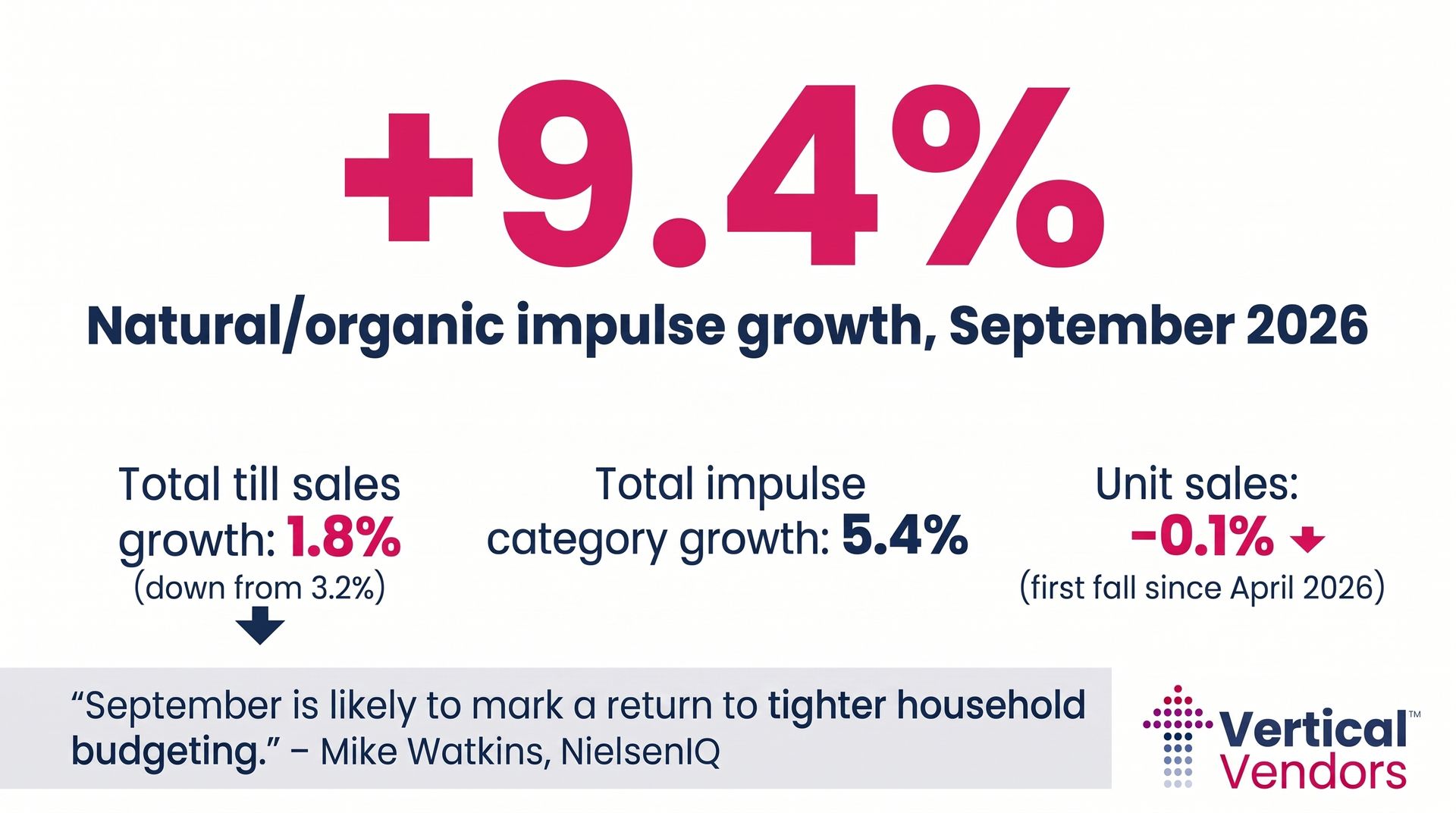
UK grocery till sales grew just 1.8% in the four weeks to 5 September 2026, down from 3.2% over the prior twelve weeks, and unit sales fell for the first time since April.
One exception: natural and organic impulse buys grew 9.4%, nearly double the wider impulse category, meaning shelf space for the categories still working now has to earn its keep.
How Much Did UK Grocery Sales Growth Slow in September 2026?
Total till sales growth roughly halved month on month, from a 3.2% twelve-week average down to 1.8% in the four weeks to 5 September. Unit sales dropped 0.1%, the first decline since April 2026. Supermarkets still grew 2.4%, but convenience stores managed just 0.3%.
Sales peaked at £4.25bn in the week ending 29 August, before the slowdown set in. Mike Watkins, NielsenIQ's head of retailer insight, put it plainly:
"September is likely to mark a return to tighter household budgeting as cost-of-living pressure builds again" (Talking Retail, 15 September 2026).
That's a sharp turn in a short space of time. Growth running at over 3% one month and 1.8% the next is a genuine shift in trajectory, not noise, and it's the kind of change that shows up first in which shelves are still converting rather than in the topline number alone.
Supermarkets vs Convenience: Where Is Growth Actually Holding Up?
The slowdown isn't hitting every channel equally. Supermarkets still grew 2.4% in the period, while convenience stores managed just 0.3%, a far wider gap than the twelve-week average would suggest.
For convenience in particular, that's a tight margin for error. Convenience baskets are smaller and more impulse-led by nature, so when category growth is running close to flat, there's very little headroom left over from the market itself. Almost all of the remaining growth has to come from what's actually stocked, faced and visible on a small footprint, not from more people simply walking through the door.
Which Grocery Categories Are Still Growing as the Market Slows?
The slowdown isn't hitting every aisle evenly. Summer lines are fading fast as the weather turns, while comfort food and specific impulse categories are picking up the slack.
| Category | Change |
|---|---|
| Ice cream | -22.6% month on month (still +8.1% year on year) |
| Olives | -16.4% |
| Fresh dips | -10.4% |
| Fresh fruit | -6.9% |
| Canned beans | +10.1% (butter beans +31.5%) |
| Gravy and stock | +4.1% year on year, +33.7% versus the prior period |
| Natural/organic impulse | +9.4% (versus +5.4% for total impulse) |
| Organic fresh food | +4.7% (versus +1.9% overall) |
Ambient grocery rose 2.9% overall as shoppers swap summer staples for comfort food. Meanwhile "all natural" and organic-labelled impulse buys are growing at nearly double the pace of the wider impulse category, even as total unit sales fall.
Organic fresh food shows the same pattern on a smaller scale, up 4.7% against 1.9% for fresh food overall, so this isn't a one-off blip in a single subcategory, it's a consistent premium/natural tilt running through several parts of the store at once.
Why This Matters for Brands and Retailers
When total growth halves and unit sales actually fall, retailers can't lean on rising footfall or bigger baskets to carry the numbers. Every facing on the shelf has to justify itself, and the data shows exactly where the remaining spend is going: natural and organic impulse, and comfort food staples like beans and gravy.
That's a shelf execution problem as much as a buying one. A category growing at 9.4% only delivers that growth at store level if it's actually stocked, faced and visible at the point a shopper is deciding on impulse, not sitting in a backroom because a flat-packed cardboard unit collapsed under restocking or wasn't refilled in time.
Immediate consumption and impulse categories are exactly the ones where display execution decides whether category-level growth shows up on a given shelf. More on the immediate consumption trend
It cuts both ways for brands supplying these categories too. A national listing and a strong NielsenIQ number won't help a brand much if the distributor or retailer they're supplying can't keep that line fronted and topped up store by store.
Brands riding a genuine growth trend right now have a real interest in what fixture their product actually lands on, not just whether the listing exists.
Seasonal resets add another layer. Ice cream is down 22.6% in a month; gravy and stock are up 33.7% on the prior period. That's a genuinely fast turnover, and every week a display is still fronting a fading summer line instead of the category that's actually growing is a week of lost sales that shows up nowhere except a slightly lower like-for-like number.
The Vertical Vendors Answer? Making Every Facing Count
This is exactly the environment permanent steel POS units are built for. A spring-loaded, self-facing unit such as our 24-Pack Standard or MegaVendor keeps stock pushed forward and fully visible without relying on extra staff hours, so the categories still converting, natural and organic impulse lines especially, stay properly presented even as overall footfall cools.
Steel units are also far quicker to reset than a cardboard equivalent when a range shifts with the season. Swapping a display from ice cream to gravy and stock doesn't mean binning a unit and building a new one, it means re-merchandising a fixture that's designed to be reused across resets for years, not replaced every time the planogram changes. Poor planogram compliance is one of the quieter profit leaks retailers carry through exactly this kind of transition (how planogram compliance affects the bottom line).
That reusability matters just as much on the smaller convenience footprint as it does in the big supermarkets. A fixture that can be re-merchandised in minutes, not rebuilt from flat pack, is what lets a small store keep pace with categories that are turning over month to month rather than season to season.
In a market where unit sales are falling and every facing has to work harder for its share of a smaller pie, the fixture holding that stock stops being a fittings decision and becomes part of the sales strategy.
FAQ
Why did UK grocery unit sales fall in September 2026? NielsenIQ data shows unit sales dropped 0.1% in the four weeks to 5 September 2026, the first fall since April, as cost-of-living pressure prompted tighter household budgeting going into autumn.
Which grocery categories grew fastest in September 2026? Natural and organic impulse buys led growth at 9.4%, alongside ambient comfort food such as canned beans (+10.1%, with butter beans up 31.5%) and gravy and stock (+33.7% versus the prior period).
How can retailers protect sales when overall grocery growth slows? By making sure shelf space and displays are working hardest for the categories still growing, full facings, fast resets between seasonal ranges, and fixtures that don't need replacing every time the planogram shifts.
Find Out More
If a slowing market means every facing on your shelf needs to convert, it's worth talking to us about how a permanent display fixture pays for itself.
Get in touch with Vertical Vendors.
More from the blog